
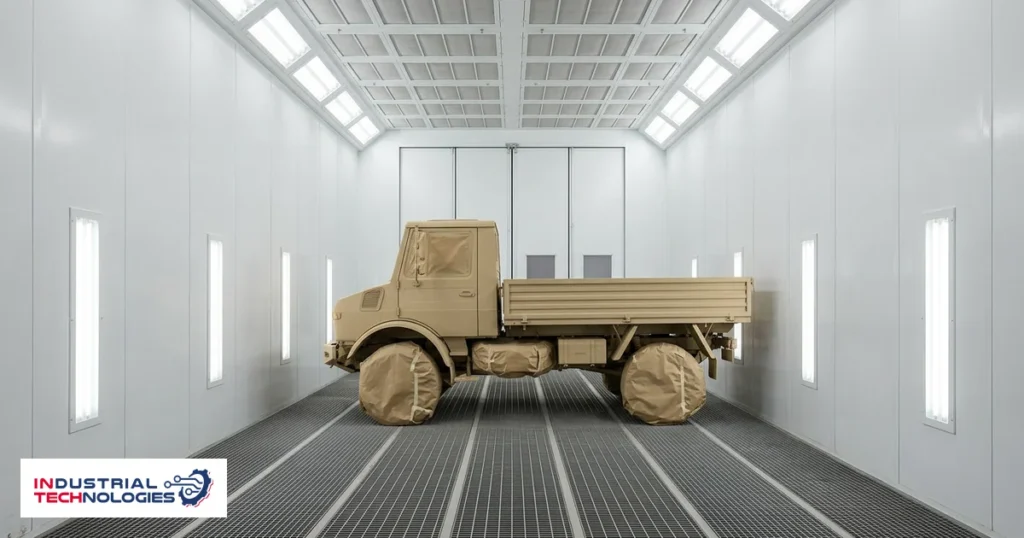
Size is measured with a tape. What is applied to the equipment changes what is inside the chamber rather than its dimensions: heat, air and filtration.
Special finishes for defense equipment are published for this sector alongside heavy vehicle and large equipment sizes and site and security requirements defined per project.
Why the material outweighs size in internal effect
The coating material sets the heat curve, the filter class and the air capacity together. Size sets the chamber’s dimensions alone. Two chambers of identical size therefore differ entirely in internal configuration if what is sprayed inside them differs.
What the family offers for this purpose
| Item | Delivered range | What tips the choice within it |
|---|---|---|
| Heating systems | Diesel · gas · electric · heat pump · short-wave infrared | Coating material and on-site energy sources |
| Filtration | Stop, pre and ceiling filtration EU3, EU4, EU5 — up to three-stage bag and high-efficiency filtration at ≥98% | Finish level required and project requirements |
| Heat output | 200,000–600,000 kcal/h | Chamber volume and coating material together |
When a controlled environment is delivered
Temperature and humidity control together is delivered on custom booths whose coating requires a controlled environment, and the range is set per project by the finishing material and the part’s requirements. It is a capability requested when the material demands it rather than a standard configuration applied to every chamber.
Frequently asked questions
What is sent to settle the internal configuration?
The coating material first, then the platform’s dimensions and the energy sources available on site. Heating system, filter class and heat output are derived from those three.
Is a controlled environment delivered for special finishes?
Temperature and humidity control is delivered on custom booths whose coating requires a controlled environment, and the range is set per project by the finishing material and the part’s requirements.
Does filtration change when the coating changes?
Filter class follows the finish level required and the material type, and a higher class gives cleaner air and raises airflow resistance at the same time — which is why it is set with the configuration rather than after installation.
Is the coating material named in the specification?
The material is described in enough detail to set the heat curve and filter class against it, and it is written into the technical specification with the other items so it remains verifiable.
Related reading
Next step
Send the dimensions and weight of the largest part or platform to be coated, together with your site area, and the internal size and configuration come back against them. Talk to a specialist. The published range sits on the paint booths family page, and the sector configuration on the Military & Defense sector page.