
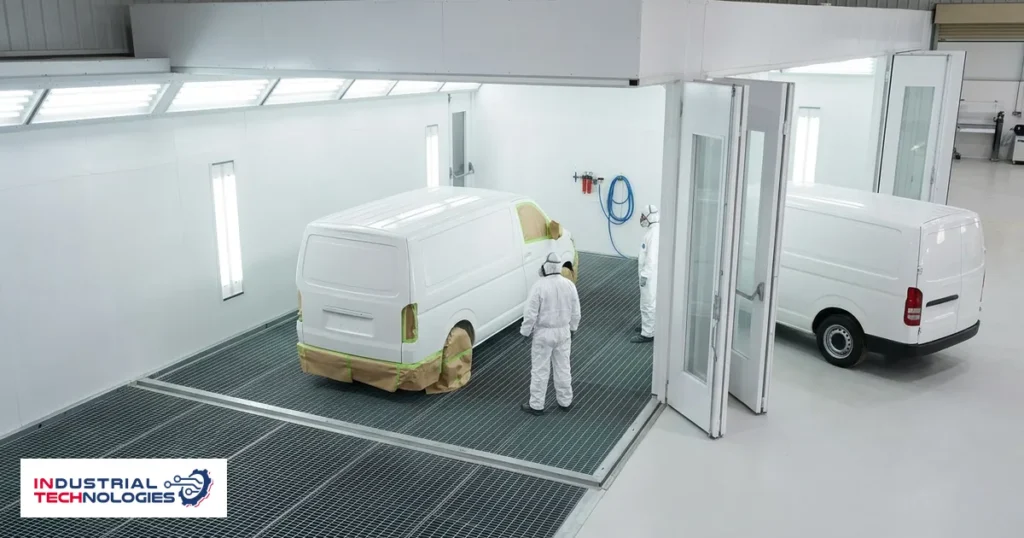
A fleet carrying one livery leaves the dealership in one colour. Two years of operation later its vehicles have passed through different workshops, each matching colour with its own tools and its own lighting — and the difference appears the moment the vehicles line up.
Fleet livery colour consistency therefore starts with where the repair happens rather than with paint quality alone: refinishing in the central workshop keeps the colour together and shortens time out of service at once.
Why colours drift at all
Colour matching is not a fully automatic process. It is a visual judgement made under particular lighting, with a mix prepared under particular conditions, applied with a spray technique that varies between technicians. Three sources of variation across dozens of vehicles produce visible drift.
A difference nobody notices on a single vehicle is noticed immediately when vehicles are parked in a row — which is exactly what a fleet does at the end of every day.
What the published configuration says about lighting
Higher lighting is listed as a configuration item for colour matching work — specifically on the collision repair row, where matching is daily work. The same principle applies to any workshop matching colours regularly, including a fleet workshop refinishing its own vehicles.
| Item | What it does | Source |
|---|---|---|
| Where repairs happen | One workshop instead of many | In-house refinishing |
| Lighting | A constant visual condition for the match | Published configuration item for matching work |
| Surface preparation | What makes a repaint last instead of repeat | Prep stations and mixing rooms |
| Cabin size | That every fleet vehicle actually fits | INTECH cabin 6,900 × 4,000 × 2,650 mm and above, built to order |
Preparation before colour
Surface preparation before painting is what makes a repaint last instead of repeat. A vehicle repainted twice in two years enters the lottery of variation twice — so good preparation serves consistency twice over: once through finish quality, and once by reducing how often the repaint is needed.
Common questions
Is the manufacturer colour code enough?
Not on its own. The code is a starting point, and a vehicle in service shifts colour through sun exposure and repeated washing, so the mix is matched to the vehicle’s condition rather than to the code alone.
Why is higher lighting singled out?
Because the matching decision is visual, and weaker lighting hides differences that reappear in daylight. Higher lighting brings the difference inside the cabin where it can still be corrected.
Is refinishing in house cheaper?
The published item claims two benefits: colour consistency and shorter time out of service. The financial comparison is built on how many repaints your fleet needs per year.
What about vehicles that do not fit the cabin?
Those are the ones repaired outside, and they become the source of the drift. That is why cabin size is fixed on the longest vehicle in the parc rather than the most frequent one.
Related reading
- Internal length for light commercial vehicles
- Logistics fleet paint system
- Government fleet workshop fit out
Next step
Send your vehicle count and how many repaints you run per year, and we will come back with a cabin and preparation configuration built on that number. Talk to a specialist. The detail sits on the fleet sector page.