
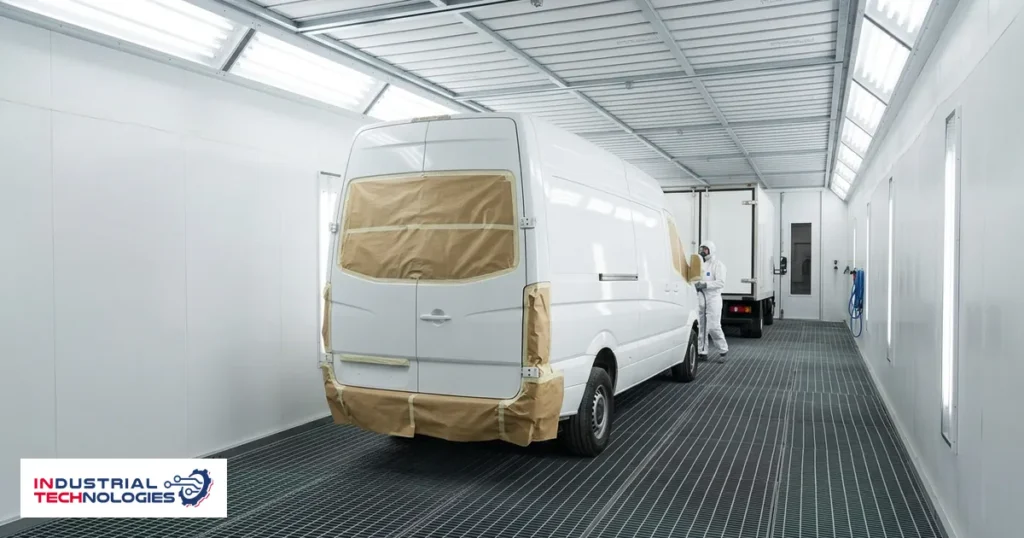
Fleets depend on scheduled preventive maintenance rather than on repair at failure. Mixing planned work and breakdowns in the same bays cancels the schedule in practice, because breakdowns always displace planned work.
Fleet maintenance scheduling booth cycles included therefore begins with allocating space rather than with an equipment list — it is a space decision before it is a purchasing decision.
Why breakdowns win every time
A failed vehicle halts a contract, a route or a service. A scheduled vehicle is running with no visible problem. When the two compete for the same bay, the breakdown wins every time — not through management error, but because operational priority dictates it.
The consequence is that preventive work is deferred until it becomes a breakdown itself, and within months breakdowns have swallowed the entire schedule.
Where the booth belongs in that order
The booth is not a quick-service bay. Its cycle is longer than an oil change or a brake inspection, and it is bound to a heat curve that cannot be interrupted midway. Putting it into the daily job queue means stalling either the booth or everything behind it.
| Job type | What governs its duration | Effect on the schedule |
|---|---|---|
| Scheduled preventive work | A fixed task list | Can be planned in advance |
| Breakdown repair | The nature of the failure | Displaces others when it shares a bay |
| Booth work | Heat curve and drying cycle | Cannot be interrupted midway |
| Underbody work | 600–1,999 mm lift height | A daily repeat in fleet operation |
What gets decided before purchase
- Dedicating bays to preventive work so breakdowns cannot crowd them out
- Keeping the booth outside the quick-job queue, on its own cycle
- Spreading lift capacities across bays by fleet mix rather than one capacity for all
The number of bays dedicated to scheduled work is set per fleet from its vehicle count and service intervals, and it does not transfer from one operation to another.
Common questions
How many bays should be dedicated to planned work?
It is calculated from fleet size, the preventive interval per vehicle and the duration of a single job. No general figure carries across fleets, because all three differ between operations.
Can the booth bay absorb quick jobs under pressure?
In practice it can, but it stalls or delays the booth work already running. The effect shows in the vehicles waiting to be painted, not in the vehicle that took the space.
What actually makes a schedule executable?
Separated bays. A schedule written on paper is not executed if it competes for the same floor space as breakdowns.
Does documentation belong here?
Yes. Operating contracts require proof of work done, so the written job record is part of scheduling rather than a step after it.
Related reading
- Fleet workshop layout
- Government fleet workshop fit out
- Last mile fleet workshop
- Annual equipment maintenance contract
Next step
Send your vehicle count, preventive service intervals and available floor area, and we will come back with a bay layout that separates planned work from breakdowns. Talk to a specialist. The full approach sits on the fleet sector page.