
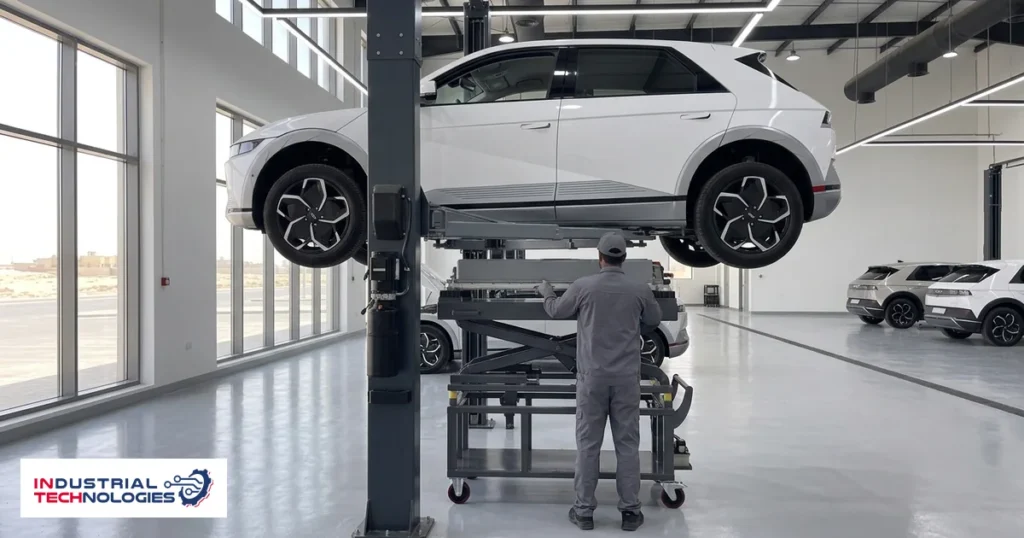
Most conversations about electric vehicles in the workshop start with chargers. Charging is real, but it is building infrastructure — an electrical contractor’s scope, not a workshop equipment decision.
What genuinely changes the bay is the battery pack: a mass of several hundred kilograms that comes down out of the vehicle and goes back into precise mounting points. EV service bay equipment is really a question of how you handle that pack safely and repeatably.
A vehicle lift does not lift a battery
Lifts in the vehicle lifts and lifting equipment family work at 4000 and 4500 kg, raising a complete vehicle from its designated lifting points.
Battery removal is the opposite motion. The vehicle stays raised and stationary while a load descends out of it. You need a surface that receives the pack, supports it, and returns it to alignment — not a second lift.
That is why the EV battery lifting platform SHL-BG 1200 is rated at 1200 kg rather than 4500, with a platform of 1350×790 mm and a lifting height of 1800 mm. Smaller numbers, different job.
Tilt is the feature that earns its place
The platform adjusts front and rear by electric hydraulic action, and it is the only unit in the family that does so.
The reason is practical. Battery mounting points under a vehicle are not reliably parallel to a flat platform surface. Without tilt, a technician ends up nudging a several-hundred-kilogram pack by hand to line up the bolts — precisely the situation the equipment exists to prevent.
Supporting that are twin cross arms on two levels and a pneumatic safety system that holds the platform in position, releasing only on a deliberate operator action. The principle matches lift locks: release is a decision, not an event.
Check the power supply before you plan the bay
Here is the detail that catches workshops during fit-out. Heavy workshop equipment generally runs on 380 V three-phase, including two-post lifts with their 2.2 kW motors.
This platform uses a 2.2 kW motor at 220 V single phase, 60 Hz. Same motor power, different supply.
If you plan an EV bay assuming three-phase throughout, you will need a single-phase outlet where you did not provide one. That is a minor item during first fix and a considerably less minor one after the floor is poured.
Mobile station or dedicated bay
This platform is the only unit in the family supplied with a trolley for moving it between bays. That is a planning option rather than an accessory.
A workshop seeing a handful of electric vehicles a month does not need a bay committed to them. Move the platform to whichever bay holds the vehicle and return it afterwards. A workshop whose volume justifies a permanent EV bay will know that from its job schedule, not from a forecast.
Why a vehicle lift does not lift a battery
The two machines differ in capacity, and in the supply you have to provide:
| Item | Vehicle lift | EV battery platform SHL-BG 1200 |
|---|---|---|
| Capacity | 4000 and 4500 kg | 1200 kg |
| What it lifts | A complete vehicle from its designated lifting points | The pack, level, to its mounting bolts |
| Platform | — | 1350×790 mm · lifting height 1800 mm |
| Supply | 380 V three-phase · 2.2 kW motors | 2.2 kW motor at 220 V single phase, 60 Hz |
Common questions
Do we need to replace our existing equipment?
No. Body, collision, refinish and suspension work do not change with the drivetrain, and existing lifts serve electric vehicles as they serve any other. What gets added is specific to handling the battery pack.
Which sectors is this platform confirmed for?
Seven industries it serves: automotive repair, collision repair, auto dealers, auto fleet, fuel stations, car rental, and education and training.
What should be arranged before the equipment arrives?
A single-phase outlet at the working position, secure storage space for a removed pack, and a level route for moving the platform on its trolley between bays. All three are cheap to arrange on a drawing and expensive to retrofit.
Where to start
Answer one honest question first: how many electric vehicles enter your workshop each month today, and how many do you expect in a year? That answer decides between a mobile platform and a dedicated bay, and stops you buying a fit-out two years ahead of your demand.
Then review the full specification of the platform, or send your bay count and vehicle mix with a request for quotation.