
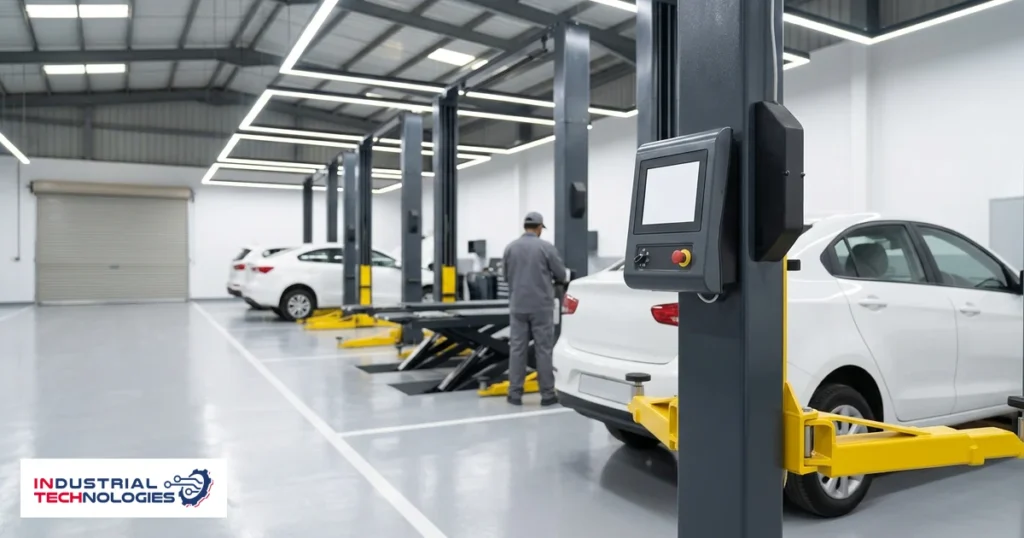
A workshop with excellent equipment and a poor sequence is a workshop that moves vehicles more than it repairs them. Every relocation is time nobody bills.
Multi bay workshop workflow is a layout problem before it is an equipment problem, and it is solved on a drawing rather than in a catalogue.
One direction, one pass
The largest hidden cost in most workshops is not the work itself but shuttling the vehicle between stations — inspect here, move, service there, move again.
The alternative is a sequential path the vehicle travels once in one direction. From the target time per vehicle you derive the number of stations and their arrangement, rather than the other way round.
That inversion is the whole discipline. A bay list assembled from a catalogue produces a collection of good machines with no path connecting them.
Separate short work from deep work
Not every job needs a fully equipped bay, and mixing them is how a thirty-minute task occupies a bay configured for a full day.
The published range supports that separation directly. The ultra-thin scissor model publishes 600 mm lift height at 4000 kg, documented as intended for wheel, brake and suspension work that does not require raising the vehicle to standing height.
Against that, the two-post clear floor models publish 1990 mm lift height with an unobstructed floor for work beneath the vehicle. Two different bays for two different jobs, and the published specifications make the distinction explicit rather than leaving it to judgement.
Machine time is fixed time
Sequencing calculations need a number for the part of the cycle nobody can compress by working harder.
The two-post models publish 50 seconds up and 30 seconds down — 80 seconds of machine time per vehicle before a tool is picked up. Over a lane running fifteen vehicles a day that is twenty minutes of bay availability decided by a specification line.
Air conditioning is the same kind of fixed time. Published vacuum pump rates of 120 L/min and 60 L/min matter because evacuation is the longest phase of that cycle, and a station in a sequential lane sets the pace for everything behind it.
Finishing sits outside the flow
Preparation and paint do not belong in a line with mechanical work, because they impose environmental requirements that mechanical bays contaminate.
The open preparation platform is a useful middle case: with no walls and no enclosed cabin, the bay stays available for general use when no preparation is running — unlike an enclosed room, which occupies its footprint permanently.
That is a sequencing decision expressed as an equipment choice, and it is the right way round for a shop that cannot dedicate floor area permanently.
The figures that set lane pace
Machine time is fixed time — these are the published figures behind it:
| Item | Published | Effect on flow |
|---|---|---|
| Two-post cycle | 50 s up · 30 s down — 80 s per vehicle | Fixed time before a tool is picked up |
| Ultra-thin scissor | 600 mm lift at 4000 kg | Short work: wheel, brake and suspension |
| Two-post clear floor | 1990 mm lift | Deep work beneath the vehicle |
| AC station vacuum | 120 L/min and 60 L/min | Evacuation is the longest phase; a slow station sets the pace behind it |
Common questions
How many bays do I need?
The figure comes from three inputs together: target availability, average duration of a single job, and the split between scheduled and unscheduled work. Send those three and the discussion becomes a layout rather than an estimate.
Does sequencing differ by sector?
Substantially. A rental operation measures turnaround between hires; a fleet operation measures readiness. What changes for each is set out on the sector pages, including car rental.
What should be fixed before ordering equipment?
The vehicle path, the station order along it, and the utility points each station needs. Equipment selection after that is straightforward; before it, it is guesswork with invoices attached.
What to send with your enquiry
Your site dimensions and clear height, daily vehicle volume, the split between short and deep work, and the target time per vehicle. Then request a quotation.