
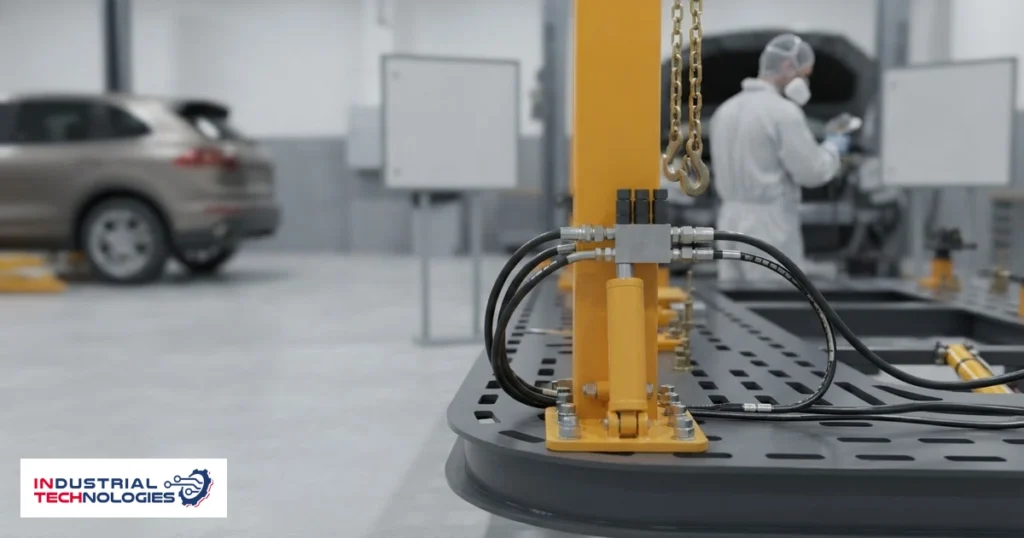
Tower count is the first number on every chassis puller datasheet, and it is usually read as a quality ranking: four towers good, two towers basic. That reading costs shops money.
Chassis puller tower configuration describes how many directions of pull you can apply in a single setup. It is a workflow decision, not a grade — and the circuit driving those towers matters just as much.
What a tower actually buys you
Pulling capacity per tower is 10 tonnes across the range. So a second tower does not double your force on a single point — it lets you apply force from a second direction without re-clamping the vehicle.
That distinction is the whole decision. Re-clamping is slow, and every re-clamp reintroduces alignment error. A shop doing complex multi-plane damage saves real hours with more towers; a shop doing single-direction corrections saves nothing and pays for capability it never uses.
Two towers: the base of the range
The INTECH CR 360 carries two hydraulic-controlled towers at 10 tonnes per tower, on a 5600 mm bench with a measuring ruler. Two towers means force from two directions in one setup.
Two figures on its sheet are worth planning around. The tilting lift platform is rated at 4000 kg, and the bench occupies 5600×2100 mm before the approach is counted.
Four towers, air or electro-hydraulic: the circuit is the real difference
The INTECH CR 500 carries four towers on compressed air at 0.6–0.8 MPa, like the CR 360. The INTECH CR 700 carries the same four towers on electro-hydraulic operation instead.
This is where a spec comparison goes wrong if you only count towers. Pneumatic and electro-hydraulic circuits have different shop requirements: one leans on your compressed air system and its duty cycle, the other is self-contained but brings hydraulic maintenance and fluid behaviour into your routine.
So the honest question when comparing these two is not “do I need four towers”, but “do I want this bench tied to my air network, and can that network carry it alongside everything else drawing from it”.
The top of the range: control and lift rather than towers
The INTECH CR 900 moves the difference elsewhere: a wider 2280 mm bench that lifts vertically as well as tilting, up to 1080 mm, with every lifting and pulling function on a hand-held wireless remote and no foot pump — at the same 10 tonnes of pulling force, for medium and heavy duty work.
Its published specification does not list a tower count. If that number matters to your decision, ask for it in writing rather than inferring it from a sibling model.
Towers, circuit and bench
Two variables change between the models, not one:
| Model | Towers | Circuit and figures |
|---|---|---|
| INTECH CR 360 | Two | Compressed air 0.6–0.8 MPa · 10 tonnes per tower |
| INTECH CR 500 | Four | Compressed air 0.6–0.8 MPa · 10 tonnes per tower |
| INTECH CR 700 | Four | Electro-hydraulic · 10 tonnes per tower |
| INTECH CR 900 | Not listed on the sheet | Wireless remote · tilting and vertical lift to 1080 mm |
| Shared across the range | Pulling force 10 tonnes · 360° range | Lifting 4000 kg |
Common questions
Does more towers mean more pulling force?
No. Rated capacity is 10 tonnes per tower across these models, so the tower count changes how many directions you can pull from in one setup, not the force available at a single anchor point.
How do I choose between electro-hydraulic and pneumatic?
Start from your existing compressed air capacity and how many tools already draw on it during a busy hour. A pneumatic bench added to a network already at its limit will disappoint on both the bench and everything else connected to it.
Which sectors are these confirmed for?
Sector coverage lists only the industries each model actually serves. The INTECH CR models serve automotive repair, collision repair, auto dealers, auto fleet and car rental.
Where to start
Look back at your last twenty straightening jobs and count how many needed force from more than one direction. If that number is small, a two-tower bench and a well-planned bay will serve you better than a larger bench used at a fraction of its capability.
Then compare the full specifications across the chassis pullers and body repair family, or send your job mix with a request for quotation.