
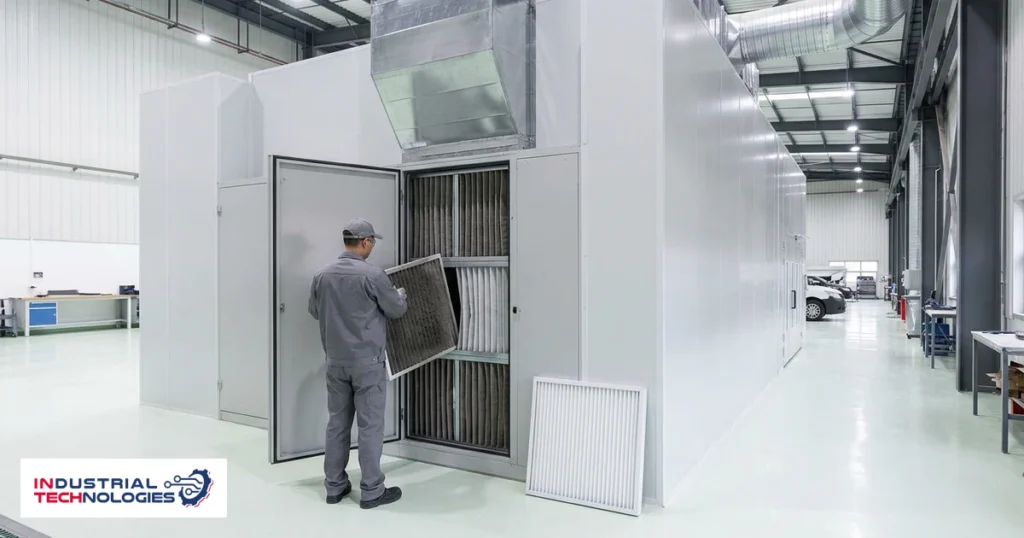
Sandstorm protection workshop planning tends to happen after the first storm rather than before it. That ordering is expensive, because the damage a storm does is mostly not the dramatic kind — it is fine particulate reaching places that were never sealed against it.
The equipment that fails is rarely the equipment that was outside.
The mechanism: intake, not impact
Storm damage is imagined as abrasion on external surfaces. In a workshop the real path is different: every piece of equipment that draws air is drawing storm air, and it draws it straight into itself.
Compressor intakes, booth pre-filters, cooling fans on power units, ventilation systems — all of them are pulling in loaded air. A storm can consume a filter that would have lasted months, in hours.
Which reframes the whole problem. This is not a building-envelope question. It is an intake management question, and it has answers that cost very little.
Before: a short list that works
- Hold spare filters — particularly pre-filters. A storm can exhaust the stock you assumed would cover a quarter.
- Shut down what you can — equipment not drawing air is not ingesting the storm.
- Cover exposed intakes — compressor and power-unit intakes especially.
- Close the booth — a positive-pressure cabin sealed and shut down protects itself well; the same cabin running with a loaded pre-filter does the opposite.
- Cover vehicles in progress — a prepped or freshly painted panel is the most vulnerable surface in the building.
None of this requires capital. What it requires is deciding it in advance, because during a storm nobody has time to work out what to prioritise.
After: what actually needs checking
| Item | Why it matters | Consequence of skipping |
|---|---|---|
| Pre-filters | Loaded fastest, by a wide margin | Airflow degrades and the fan overworks |
| Compressor intake filter | Direct route into the machine | Reduced delivery, accelerated wear |
| Lift ratchet mechanisms | Fine dust can prevent full engagement | Safety function compromised silently |
| Lighting covers | Dust layer absorbs light | Illumination drops below the level defects need |
| Cooling fans and vents | Blocked airflow means heat | Thermal shutdown at peak load |
| Booth seals and doors | Positive pressure depends on them | Dust ingress into the cabin |
The lift ratchet entry is the one we would highlight. Every other item on this list announces itself through degraded performance. A fouled ratchet does not — it looks and sounds approximately normal until it fails to engage.
The cumulative effect nobody logs
A single storm rarely destroys anything. What it does is advance the wear clock across a whole shop simultaneously, and because it happens everywhere at once, it does not register as an event.
Months later a shop finds several unrelated pieces of equipment underperforming, and the diagnosis becomes “everything is getting old”. It usually is not.
The practical countermeasure is a log: record the date, and record what was replaced or cleaned afterwards. Two seasons of that turns your maintenance schedule from a calendar into something matched to your actual site.
Design decisions that pay off later
At fit-out stage, some choices reduce exposure permanently and cost nothing extra if made early: intakes positioned away from prevailing wind and unpaved approaches; the compressor in a shaded, filtered enclosure rather than an open corner; surface-mounted equipment that seals more readily than pit installations.
Retrofitting any of these afterwards costs several times what specifying them correctly on the drawing would have.
Common questions
Should the paint booth run during a storm?
Running it means drawing storm air through the filtration at maximum load, which consumes filters rapidly and risks carrying particulate to the panel. Sealed and shut down protects both the cabin and the work in it.
How much spare filter stock is sensible?
Enough to change pre-filters immediately after a storm without waiting on supply — that is the specific scenario worth covering. The quantity depends on your models and your site exposure, and a season of logged replacements will tell you more accurately than any general figure.
Does this apply to a fully enclosed workshop?
Yes, because the exposure is through intakes rather than through the envelope. An enclosed building whose ventilation and compressor intakes draw outside air is still ingesting the storm — the walls are not the protection people assume they are.
What is the highest-value single action?
Holding pre-filter stock. It is inexpensive, it addresses the fastest-degrading component, and it removes the temptation to keep running on a loaded filter because the replacement has not arrived.
Where to start
The spray booth filter guide covers filtration stages and how to manage them by pressure rather than by date — which is the discipline that makes storm recovery routine rather than disruptive. Published equipment sits under products and solutions.