
Filters are the cheapest consumable in a spray booth and the one most likely to be managed badly. Nearly every booth “fault” we are called to turns out to be a filter that was left past its useful life, producing symptoms that read as mechanical.
Any useful spray booth filter guide has to start there. The complication in this region is that published change intervals assume temperate ambient conditions. They do not survive contact with a site near an unpaved road, and following them literally is how shops end up chasing phantom faults.
Three stages, three different lifespans
Treating “the filter” as one line item is the root error. A booth has three filtration stages, and each is consumed by a different variable:
- Pre-filter — takes ambient dust first. Consumed by site conditions, and by a wide margin the shortest-lived stage here.
- Ceiling filter — determines the cleanliness of air descending onto the panel. Consumed by hours of airflow.
- Exhaust filter — captures overspray on the way out. Consumed by material sprayed, not by elapsed time.
Two shops with identical production schedules can differ substantially in pre-filter consumption purely because of where they sit. Which is why a calendar-based schedule, on its own, is the wrong instrument.
Manage by differential pressure, not by date
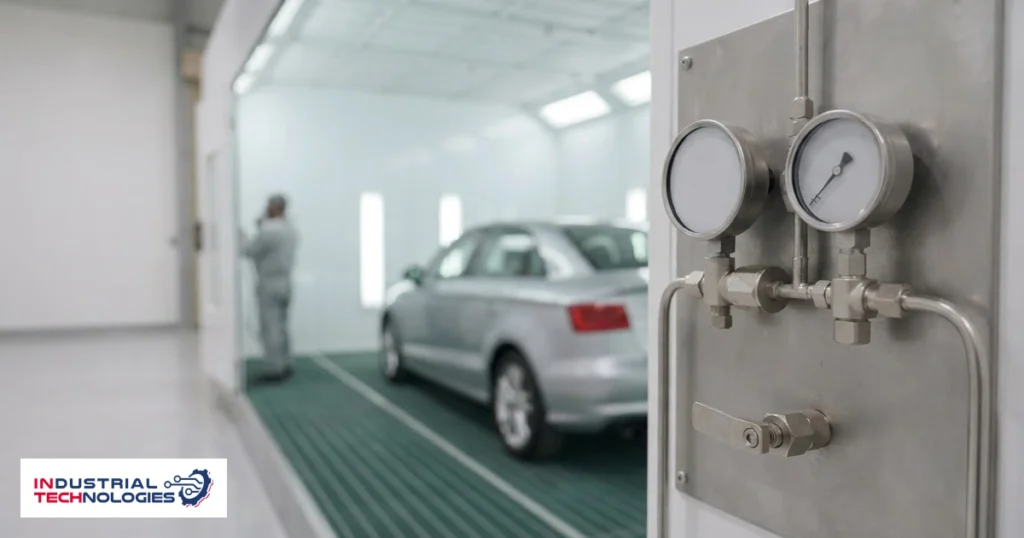
A loaded filter resists airflow, and that resistance shows as a rising pressure differential across it. That reading describes the filter’s actual condition — the calendar describes only its age.
This is also where fan static pressure earns its cost. A fan specified at 650 Pa holds its airflow while filters load. A weaker fan delivers the quoted figure on handover day and quietly loses it week by week, with no alarm and no obvious symptom until finish quality drops.
If the booth has no differential gauge, the practical substitute is to log time-to-cure-temperature weekly. A steady upward drift is a reliable early signal.
Do not clean filters with compressed air
This happens often and the motive is understandable — filters are a recurring cost. But blowing a filter out opens channels through the filter medium. Air then takes those channels while the rest of the element stays blocked.
The pressure reading improves. The filtration does not. You have purchased a reassuring number instead of a working filter, and the contamination it was holding is now inside the booth. This is one of the few points on which we would give no qualified answer: do not do it.
A practical inspection frame
| Stage | Driven by | What to check |
|---|---|---|
| Pre-filter | Site dust load | Visible loading and differential pressure — weekly in dusty locations |
| Ceiling filter | Airflow hours | Even distribution, frame seal integrity |
| Exhaust filter | Material sprayed | Saturation, not calendar date |
| Cabin seals | Door cycles | Positive pressure depends on these |
⚠️ These are planning frames, not manufacturer commitments. The binding interval for your model comes with its manual and takes precedence wherever the two differ.
The economics people get backwards
Extending filter life to save money is a false economy that is easy to prove. A degraded pre-filter means dust reaching the panel, which means rework. One reworked panel typically costs more in labour and material than a season of filters.
There is also a compounding effect people miss: a loaded filter forces the fan to work harder for the same airflow, which shows up in energy consumption every hour the booth runs.
Common questions
Are filters covered by warranty?
No. Filters, belts and consumables are explicitly excluded, and the applicable warranty is the manufacturer’s own with its stated duration and conditions. Clause 9 of the terms and conditions covers this.
How do I know a filter needs changing before quality drops?
Track two indicators rather than one: differential pressure across the filter if a gauge is fitted, and time-to-cure-temperature. Either drifting upward precedes visible finish defects by weeks — that gap is the window you want to act in.
Can shop staff handle filter changes?
Yes, with brief training — inspection and replacement are routine work. Burner servicing and temperature calibration are a different matter and need tools and experience. The practical split is routine in-house, technical intervention on indicator rather than on a fixed visit schedule.
Which defect points to which stage?
The sequence is diagnostic. Specks and inclusions in the finish point to filtration first. Slow drying points to the burner or to airflow. Material flow defects point to downdraft velocity outside its band. The symptom that appears first identifies the stage that was neglected.
Where to start
Published models and their airflow figures are under paint booths and finishing systems, and the companion note on reading an airflow specification covers the numbers that determine how much filter margin a booth has to begin with.