
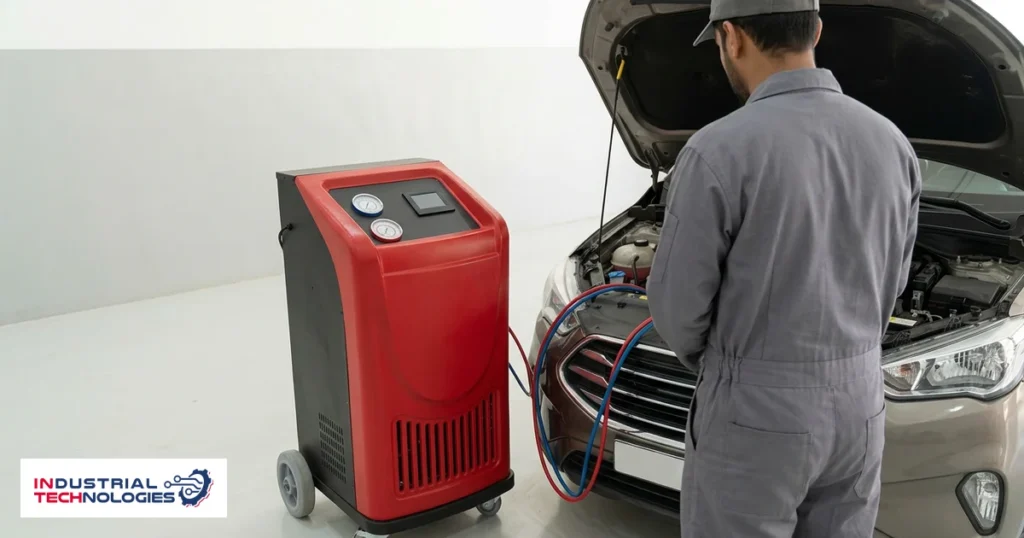
Air conditioning service equipment is bought on price more often than on accuracy. That ordering is backwards, and the cost of getting it wrong does not appear in the purchase invoice — it appears in refrigerant consumption and in vehicles that come back.
AC service station accuracy is the specification that repays attention, and this note covers the four figures that determine whether a station earns its place in a busy bay.
Charge accuracy is the specification that matters most
Modern systems are charged to a tolerance the manufacturer defines tightly. The margin between a correct charge and an overcharge can be under a hundred grams. A station weighing to ±10 g on refrigerant and ±5 g on oil keeps you inside that window. A less accurate one puts you outside it while the display tells you otherwise.
Overcharging does not produce colder air, which is the assumption behind most of the damage we see. It produces higher head pressure, reduced cooling and additional load on the compressor. You pay twice: once for the surplus refrigerant, and again in compressor life.
Which is why accuracy is the first line we read on any AC station specification — ahead of tank capacity and well ahead of the function count on the front of the brochure.
Recovery rate shows up in your gas invoice
A 99% recovery rate means the station returns to its tank essentially everything it drew from the system. Against 95% that looks like a rounding difference on paper. It is five times the loss.
Multiply by monthly vehicle throughput and the figure stops being a specification and becomes a line in your operating cost. It is also one of the few specifications a buyer can model honestly before purchase: vehicles per month, grams lost per vehicle, done.
Vacuum performance and the moisture problem
A 120 L/min vacuum pump evacuates air and moisture from the circuit before charging. Residual moisture combines with system oil to form acids that attack components from the inside — a failure that surfaces months later and is rarely traced back to the service that caused it.
A workshop that shortens evacuation time to release the bay faster is manufacturing its own repeat work. This is one of the cases where speed is a straightforward loss.
Reference figures
| Parameter | Published value | Operational effect |
|---|---|---|
| Scale accuracy | ±10 g gas · ±5 g oil | Correct charge first time |
| Recovery rate | 99% | Direct line in refrigerant cost |
| Vacuum pump | 120 L/min | Moisture removal before charging |
| Recharge rate | 2 kg/min | Bay time per vehicle |
| Tank capacity | 12 L | Vehicles served between refills |
| Functions | 8 | Recovery · recycle · vacuum · recharge · flush · UV leak test |
Leak detection pays for itself in avoided rework
Charging a system that leaks wastes the refrigerant, returns the customer in a fortnight, and costs you their confidence. UV dye leak detection makes the leak literally visible before you charge.
In a high-throughput bay that single function justifies the price gap between two stations — not because of the gas it saves, but because of the bay hour it saves from being occupied by a returning vehicle.
Common questions
Does the station handle R-1234yf?
This must be established explicitly per model before purchase. R-134a and R-1234yf equipment is not interchangeable, and cross-charging damages both the charge and the station. Supported refrigerants are fixed in the quotation for each model — request that in writing rather than accepting a verbal assurance.
Fully automatic or semi-automatic?
A fully automatic station runs the complete cycle once values are entered, which removes operator error and frees the technician during the cycle. Semi-automatic costs less and needs manual intervention between stages. At meaningful daily volume, the price difference is recovered in technician time alone.
Does performance hold up in summer heat?
The station itself operates, but where you run it is the real variable: a shaded bay with reasonable ventilation. Operating in direct sun raises tank pressure and slows the cycle. That is an operational detail no specification sheet carries, and it makes a genuine difference to throughput.
What routine maintenance does it need?
The core items are the filter drier, vacuum pump oil, and scale calibration. Intervals depend on the model and on your throughput, and are supplied with the unit — we would not recommend adopting a generic schedule carried over from a different model.
Do you service equipment bought elsewhere?
Under annual maintenance contracts for large companies and dealerships, yes. Individual requests outside our own supply are not within the current service scope.
Where to start
Models and their published figures are under AC service stations, and the ACMAS301 page carries the full sheet. If you run a fleet rather than a retail bay, the auto fleet page covers what changes when air conditioning shifts from a service item to scheduled preventive maintenance across hundreds of vehicles.