
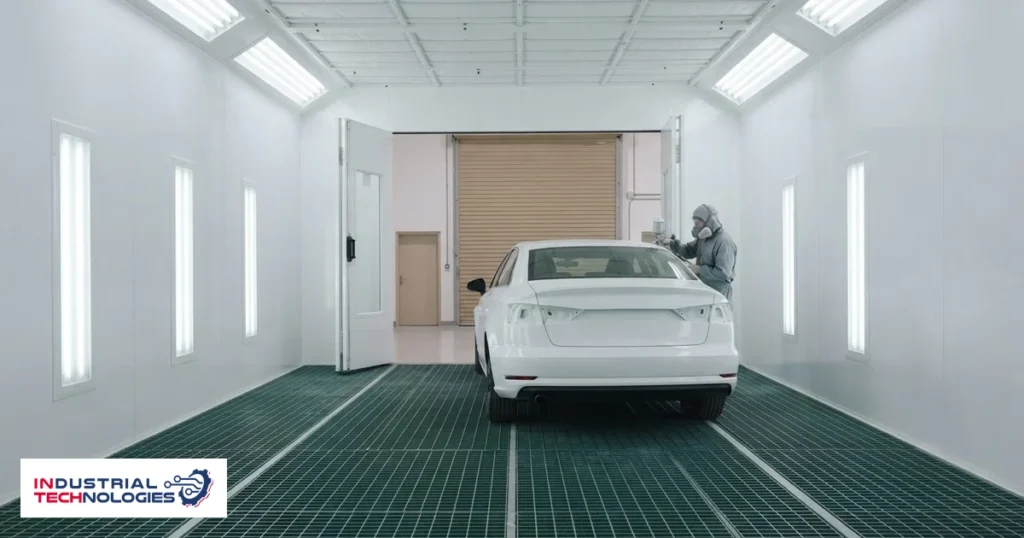
Every paint booth quotation you will receive claims a downdraft velocity of around 0.3 m/s. Almost none of them tell you where that figure was measured, or with what filter condition. That omission is not an accident — it is where the difference between two quotations actually lives.
A paint booth airflow specification is a measurement report, not a product attribute. This is a procurement note, not a physics lesson. It covers what to ask, what a credible answer sounds like, and which numbers deserve to be written into the purchase order.
The velocity figure is a measurement, not a property
Airflow velocity in a spray booth is not a fixed attribute of the cabin. It is a reading taken at a particular height, at a particular point on the floor plan, with filters in a particular state. Change any of those three and the number changes.
So when two suppliers both write 0.3 m/s, they may be describing two very different cabins. Ask each of them the same three questions, in writing:
- At what height above the floor was this measured?
- Filters new, or after a defined loading period?
- Averaged across how many measurement points?
A supplier who answers precisely has measured. A supplier who answers vaguely has copied a number from a brochure. In practice that single exchange separates the field faster than any other question in the process.
Why supply and extract volumes are quoted separately
A well-written specification gives two air volumes, not one. On a mid-size cabin these might read 20,000 m³/h supply against 18,000 m³/h extract.
The imbalance is deliberate. More air entering than leaving keeps the cabin at positive pressure, so air escapes through every gap rather than being drawn in. That is the entire mechanism preventing workshop dust from settling on a panel sprayed ninety seconds earlier.
In a dusty operating environment this stops being a refinement and becomes the specification. A quotation that gives one combined air figure has not been read carefully enough to compare.
Fan static pressure: the number that ages
Static pressure — 650 Pa on the cabin referenced here — is the reserve that keeps airflow stable as filters load. It is invisible on handover day and decisive six weeks later.
This matters more in Gulf conditions than most European specification sheets assume. Filter intervals published for temperate climates rarely survive contact with a site near an unpaved road. Pressure reserve is what you are buying when you pay the difference between two otherwise similar cabins.
Reference figures
| Parameter | Published value | What it governs |
|---|---|---|
| Downdraft velocity | 0.3 m/s | Finish quality and material consumption |
| Air volume | 20,000 supply / 18,000 extract m³/h | Positive pressure against dust ingress |
| Fan static pressure | 650 Pa | Airflow stability as filters load |
| Illumination | ≥ 800 lux | Defect visibility before handover |
| Heat output | 200,000 kcal/h | Time to reach cure temperature |
| Supply | 380 V three-phase 60 Hz | Existing panel headroom |
Illumination is the cheapest specification to get right
At 800 lux and above on the work surface, a technician sees a defect while standing at the panel. Below it, the defect is found by the customer in daylight two days later.
It is also, relative to airflow engineering, inexpensive to specify properly at the point of purchase and expensive to retrofit afterwards. If a supplier is flexible on one line item, this is not the one to concede.
What the specification sheet will never tell you
Floor level and electrical headroom. Projects stall on these two far more often than on the equipment. Before the model is chosen, someone should answer: how much spare capacity remains on the existing panel, and is the slab level enough for the installation tolerance?
Both answers are available in an afternoon. Neither is available after the cabin has shipped.
Common questions
Is a larger cabin always the safer choice?
No — usually the opposite. A larger volume needs proportionally more air and more heat to reach the same conditions, so it raises your cost on every cycle, including the small vehicles that make up most of the work. Specify for the largest vehicle you genuinely accept, with sensible margin rather than doubled margin.
How do I compare two quotations with near-identical numbers?
Fix the measurement conditions first, then compare. Require velocity at the same height with filters in the same state, and require the two air volumes separately rather than combined. Most apparent differences disappear once the measurement basis is equalised — and whatever survives that is a real difference worth pricing.
Are filters covered under warranty?
No. Filters, belts and consumable parts are explicitly excluded. The applicable warranty is the manufacturer’s own, with its stated duration and conditions — we do not issue a parallel warranty alongside it. Clause 9 of the terms and conditions sets this out in full.
What does a booth cost?
There is no single figure that can honestly be published, because cost moves with cabin size, air volume, configuration and what your site already has. Those four are established first and the quotation is built on them — which is what the quotation request collects.
Where to start
Read the published models and their figures under paint booths and finishing systems. If your work is accident repair rather than general refinishing, the collision repair page sets out what changes in the configuration for that throughput pattern.
We supply and commission across the Kingdom, and configurations are built against your cabin size and duty rather than selected from a fixed list.