
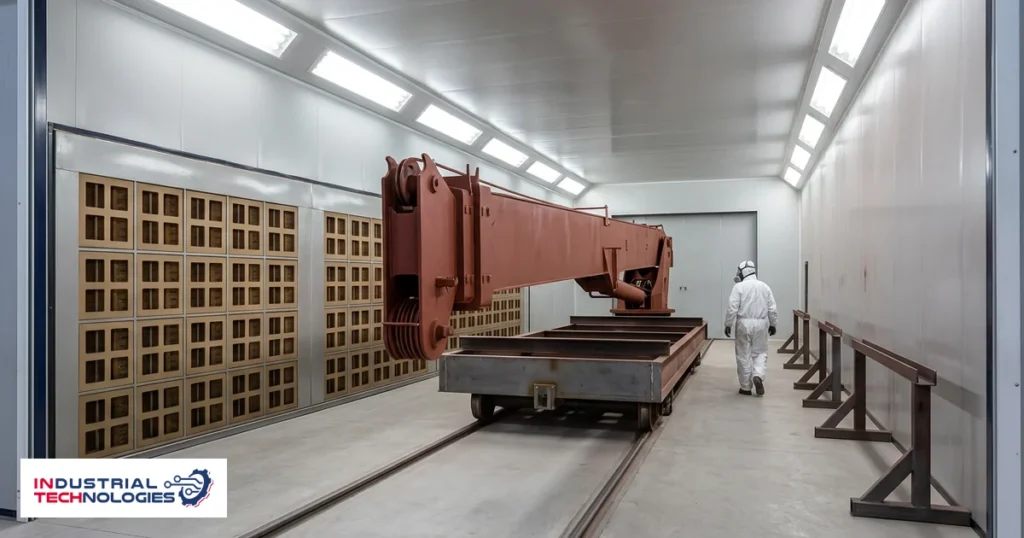
When the largest part’s size is requested, length, width and height arrive. Weight usually does not — even though it sits right beside size in the first set of inputs.
Part weight in chamber design matters because weight settles a question that comes before size: is the part hung at all, or moved at floor level?
Why weight precedes the height calculation
A light part is hung from above, so internal height becomes part height plus the frame above it plus the air distance. A heavy part is moved at floor level, so internal height becomes part height plus the air distance alone. Two parts of identical height and different weight therefore ask for two chambers of different height.
Three items weight touches
| Item | Effect of weight |
|---|---|
| Loading method | Hung from above, on a conveyor, or on a floor stand |
| Internal height | Follows the loading method rather than part height alone |
| Floor and movement layout | Follows how the part is moved inside the chamber and out of it |
Where weight sits in the input list
The four inputs for an industrial chamber are: the largest part’s size and weight, how it is hung or conveyed, the finishing material, and the line’s throughput. Weight is not a fifth item but half of the first one, which is why it is sent with the size rather than after it.
Frequently asked questions
Is the weight of every part needed, or the heaviest?
The heaviest. The specification is built on the upper limit rather than the average, exactly as dimensions are built on the largest part rather than the usual one.
What if part weights vary widely?
State the spread explicitly with the heaviest and the lightest, because a chamber covering a wide weight range may need more than one loading arrangement within the same configuration.
Does weight affect air capacity?
Air capacity is derived from chamber volume and finishing material. Weight affects it indirectly: it changes the loading method, the loading method changes internal height, and height is part of the volume.
What is sent alongside the weight?
The three dimensions of the largest part, its current loading method if one exists, the finishing material, and the line’s target throughput. Those are the four inputs in full.
Related reading
- Industrial city permits for finishing
- SASO conformity for imported equipment
- Tender specification writing
Next step
Send the dimensions and weight of the largest part or platform to be coated, together with your site area, and the internal size and configuration come back against them. Talk to a specialist. The published range sits on the paint booths family page, and the sector configuration on the Industrial & Manufacturing sector page.