
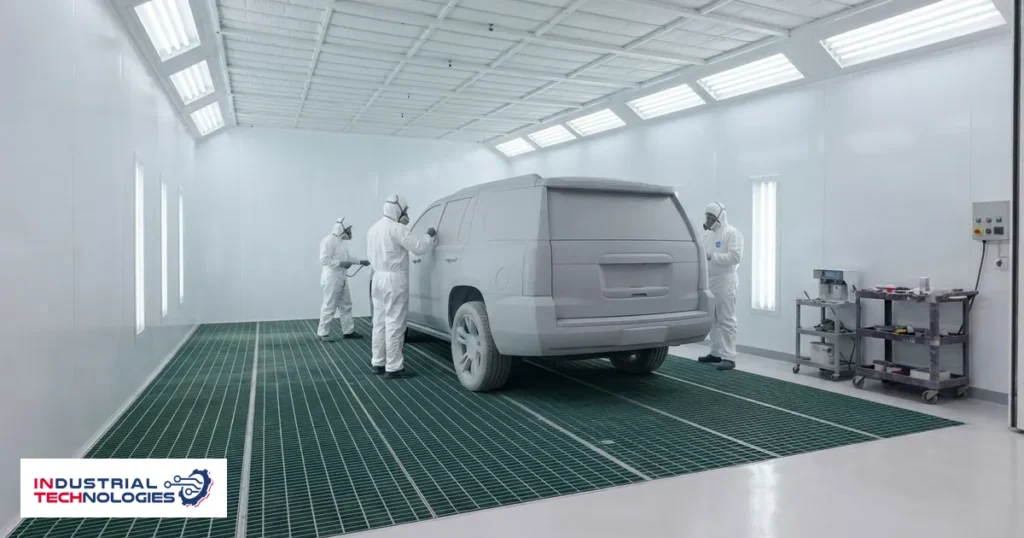
The difference between the two extraction directions is not a difference in general efficiency. It is a difference in the path air takes after it touches the part, and in what that path demands of the floor and the ducting.
The choice of downdraft or side draft on large structures is settled in this family against the nature of the work, and it is published as part of the aerospace, marine and rail configuration.
What separates them in practice
Downdraught pulls air from the top of the chamber to the bottom, so it passes over the part on its way down and leaves beneath it. Side extraction takes it out through the side of the chamber. The first imposes an arrangement in the floor, which is why cabins with a full steel-grid pit require an excavation or an entry ramp.
Where the two options are published
| Item | What is published |
|---|---|
| Direction | Downdraught or side extraction depending on the work |
| Sector named | Aerospace, aviation, marine and rail |
| Filtration alongside | Requirements beyond the automotive footprint |
| Floor implication | Full steel-grid pit needs excavation or entry ramp |
And the decision is closed early
Extraction direction is one of the four decisions signed off before manufacture, with heating system, filtration stages and doors. It is taken first because it touches the floor, the duct route and the stack position together — items settled during the site survey rather than after installation.
Frequently asked questions
Which one gives a better finish?
What is published ties the choice to the nature of the work rather than to a general preference. What is measured on finish is ceiling filtration, the heat curve and air capacity, and the classes delivered are EU3, EU4 and EU5 up to three-stage bag and high-efficiency filtration at ≥98%.
Does downdraught always require a pit?
What is published is that cabins with a full steel-grid pit require an excavation or an entry ramp. That item is settled at the site survey, read alongside the suitable concrete floor required.
What air capacity applies in airframe cabins?
It reaches 190,000+190,000 m³/h in large-structure cabins, within a general range of 18,000 to 190,000 m³/h per supply or extraction set.
Does this apply to the automotive footprint?
INTECH models are built on a 6900×4000×2650 mm cabin with a published fixed configuration per model. The two options above apply to chambers designed and built to order.
Related reading
- Colour Matching After Modification
- Configuration Sign Off Before Manufacture
- EU3 EU4 EU5 Filter Classes
What to do next
Send the dimensions of the largest part to be coated, your site area and the supply capacity available, and we will come back with an internal size and a configuration built on it. Talk to a specialist. The published range sits on the paint booth family page.