
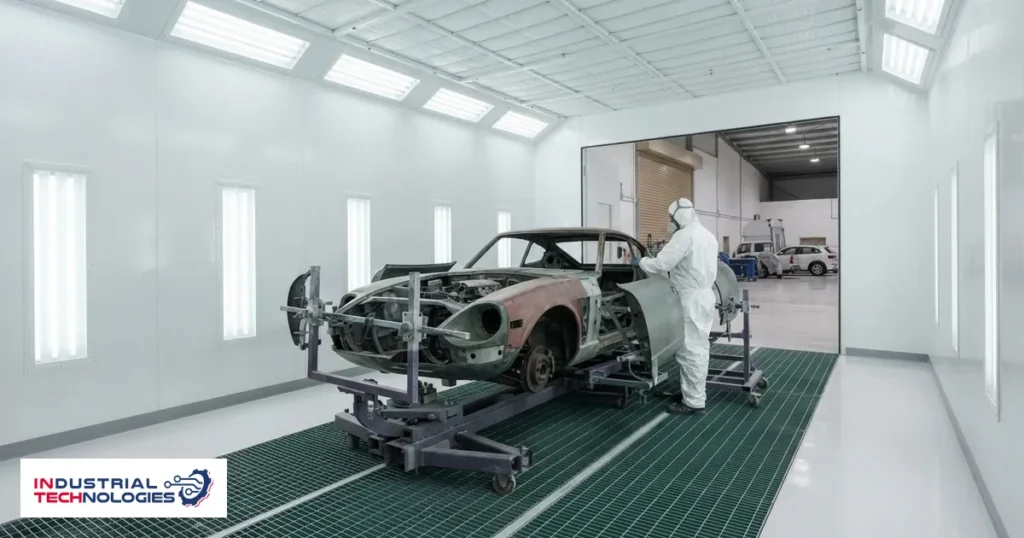
On a stock model the extraction direction arrives settled with the product. On a custom booth it is a decision to be taken, and it is taken early because everything downstream is built on it.
Extraction direction in a custom booth is set by the part being coated and the nature of the industry, alongside internal size, cabin height, heating system and filtration stages.
Why the part decides it
Air passes over the coated surface and carries overspray away from it. The shape of the part is what determines where that overspray gathers: a wide horizontal surface behaves differently from a tall structure, and a hung part differently from a vehicle standing on its wheels.
The four decisions closed with it
| Decision | What it is settled against |
|---|---|
| Extraction direction | The part being coated and the nature of the industry |
| Heating system | Coating type and the cost of energy on site |
| Filtration stages | Size, type of work and finish level |
| Doors | The widest and tallest section passing through |
And what changes by industry
In aerospace, marine and rail the direction is downdraught or side extraction depending on the work, with filtration and safety requirements beyond the automotive footprint. In woodworking and furniture the requirement is extraction that handles dust and overspray together — a different demand from overspray alone.
Frequently asked questions
Can the direction be changed after installation?
Extraction direction is closed at configuration sign off, because ducting, fan positions and the filter box are manufactured against it. Changing it later is a change to the booth rather than an operating setting.
What air capacity goes with it?
Delivered air capacity runs from 18,000 to 190,000 m³/h per supply or extraction set. Capacity is built on chamber volume, and the direction determines how that air is distributed inside it.
Is it different in large-structure cabins?
Yes. Airframe cabins reach 24,000×20,000×6,000 mm with air capacity of 190,000+190,000 m³/h, three-stage bag and high-efficiency filtration at ≥98%, plus gas monitoring and static discharge.
What should be sent to settle the direction?
Send the part type, its dimensions and how it enters the chamber, and whether it is coated standing or hung. In industrial work, add the arrangement for hanging or conveying parts inside the cabin.
Related reading
- Downdraft or Side Draft on Large Structures
- Colour Matching After Modification
- Configuration Sign Off Before Manufacture
What to do next
Send the dimensions of the largest part to be coated, your site area and the supply capacity available, and we will come back with an internal size and a configuration built on it. Talk to a specialist. The published range sits on the paint booth family page.